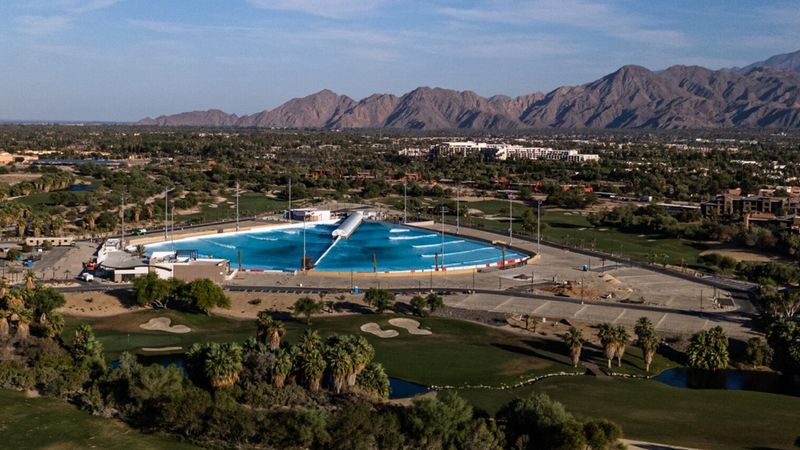
Europe has an odd relationship with surf parks. The continent already has Hossegor, Mundaka, Ericeira, and the entire Atlantic coast of Portugal, which is to say some of the best ocean surf on the planet. It also has terrible weather, short winter days, and a lot of people who live six hours from the nearest rideable wave. That second group is why twenty-two wave pools are now open and bookable across Europe.
They split into two kinds, and the distinction matters more than the price. Six are surf lagoons, where the wave travels and you ride it down the line the way you would in the ocean. The other sixteen are standing waves, where a sheet of water is held in place and you ride it without moving. Both are real surfing. Only one of them is practice for a surf trip.
The six lagoons come first, five of them destination parks. The sixteen standing waves follow, and they are where the value is.
The Wave Bristol, England
The one that proved the model works in Britain. The Wave opened in 2019 in Easter Compton, just north of Bristol, and runs a Wavegarden Cove with five distinct settings covering everything from first-timer whitewash to expert barrels.
Pricing is dynamic and moves by season and time slot: as of 23 October 2026 the booking page lists every session from Improver to Expert Plus from £42 for adults and £37 for juniors aged 6 to 16, and October dates read £47 on weekdays and £55 at weekends. The park closes for January and the first half of February.
Good to know, and it comes up in review after review: the free car park is about a 15-minute walk from the clubhouse and the lake, which is a long way to haul a board and a wetsuit in Bristol weather. It remains the most complete surf park experience in the UK, with real infrastructure around the wave.
Best for: Anyone in England who wants a guaranteed session at a park that has had six years to work out the kinks.
Lost Shore Surf Resort, Scotland
The newest of the UK pair and, for a certain kind of surfer, the more interesting one. Lost Shore sits in Ratho, about 20 minutes from Edinburgh, and runs a Wavegarden Cove with more than 20 wave settings.
Beginners start with 90-minute lessons from £65, with all gear provided. Adult surf sessions are £60 for Cruiser, Cruiser Plus and Turns, £70 for Manoeuvres, Barrels and the other advanced settings, and £80 for the Air Wave, with a soft foam board included; children's sessions start from £50. Wetsuits are compulsory in sessions and rent for £8 a day, including boots, gloves, hood and helmet, and upgraded boards cost £15 to £30. The UK pair are compared side by side in our UK surf park guide.
Two things to plan around. First, the water is not heated, and Scotland is Scotland. Wetsuits are included with lessons and rent for a small fee on open sessions, and Lost Shore's own FAQ says a surf can be postponed with a full refund if the water drops below a set temperature, which tells you what a winter booking is exposed to. Second, there is a mandatory 60-minute pre-check-in for safety briefings and waivers, so a one-hour session is really a two-hour commitment on the calendar.
Best for: Barrel hunters. A bookable, repeatable tube ride at this price is the best deal of its kind in Europe, and there is nowhere else in Scotland you can get one on demand.
Alaia Bay, Switzerland
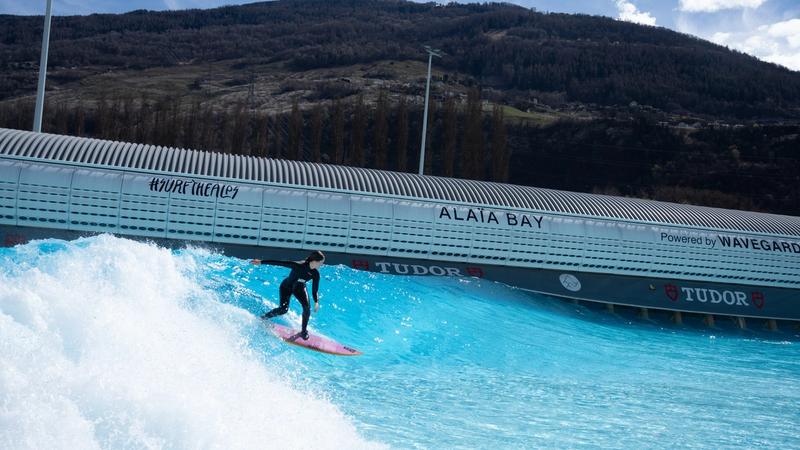
The strangest and most photogenic of the lot. Alaia Bay opened in May 2021 in Sion, in the canton of Valais, and was continental Europe's first dedicated commercial surf pool. It is a Wavegarden Cove surrounded by Alps, roughly an hour from Lausanne, and close enough to Verbier, Crans-Montana, and Zermatt that a ski-and-surf day is a real itinerary rather than a marketing line.
It is also the most expensive on this list, and seasonal: the 2026 season ends on Sunday 1 November. A guided session starts at CHF 129 and a coached one at CHF 149, which includes a foam board and wetsuit for beginner bookings. Free Surf sessions, unstructured and aimed at experienced surfers, start at CHF 89. Packs bring the per-session cost down: five sessions from CHF 599 (about CHF 120 each) and ten from CHF 1,149 (about CHF 115 each).
The structural catch is the pool layout. Unlike larger Cove sites with a separate learner bay, Alaia Bay has one wave section, the Reef, used by every level on a rotating hourly schedule. There is no dedicated flat-water beginner area, and the wave has a steep, quick takeoff that is harder to manage than a mellow beach section. Beginners can absolutely learn here, but the curve is real.
Best for: Anyone already in the Alps, and anyone who wants a session in a setting no coastal park can touch.
O2 SurfTown MUC, Germany
The technological outlier. O2 SurfTown MUC runs Endless Surf's pneumatic system rather than a Wavegarden Cove, and it is the flagship reference site for that technology, the same platform now going into The Point in Florida and Draper in Utah.
Every session tier now starts at EUR 95. Point Break sessions, the longer performance setting, cost EUR 159. Packages bring the price down: five sessions for EUR 449 and ten for EUR 849 are open to anyone, while the 25-session (EUR 1,999) and 50-session (EUR 3,799) packs are for members only.
The friction here is geography and honesty about it. Hallbergmoos is not Munich. From the city centre it is roughly 30 minutes by car or close to an hour on public transit, via the S8 train and then a bus. That overhead turns a casual after-work session into a planned outing, particularly in a Bavarian winter. Combined with EUR 95 as the entry price, this is a park you schedule rather than one you drop into.
Best for: Intermediate and advanced surfers who want the deepest wave programming in Europe and can absorb the cost and the commute.
RiF010, Rotterdam, Netherlands
Not really comparable to the others, and that is the point. RiF010 is a SurfLoch wave dropped into a working canal in the middle of Rotterdam, surrounded by restaurants and pedestrian traffic. It is the cheapest lagoon on this list after Nomadas.
Sessions run one hour and are priced by wave height: EUR 45 for the 1.0m Rookie setting, EUR 50 for the 1.2m to 1.5m sessions, and EUR 60 for the 1.6m Expert and Expert barrel sessions. Sessions are unguided and gear is not included; you rent a board and wetsuit or bring your own. Ninety-minute lessons from EUR 50 include gear.
Know the limits before you book a flight. A new wave arrives every seven seconds and rides run about eight to nine seconds, and the operator says a full session averages 11 to 13 waves per surfer. The canal water is unheated, so a winter wetsuit, hood or booties are recommended early and late in the season.
Best for: A cheap, fun add-on if you are already in Rotterdam, rather than a destination trip on its own.
Nomadas Surf Park, Spain
The smallest lagoon here, and the newest. Nomadas Surf Park opened in July 2026 in an industrial estate in El Puerto de Santa María, near Cádiz, and the city bills it as the first wave pool of its kind open to the public in Spain. The pool is about 900 square metres, 65 metres long by 14 wide, and runs on technology the Romero family developed in El Puerto, filled from a seawater well.
An hour of free surf without an instructor costs EUR 30, the cheapest hour at any park in this guide, and an hour-long lesson costs EUR 35 with board and wetsuit included. Both run Monday to Saturday for at most four people, and free surf needs at least three to go ahead. A EUR 180 annual membership, capped at 200 people, halves the free-surf price to EUR 15 up to twice a week.
Good to know: under-16s must wear a helmet in the pool, the centre asks you to arrive 30 minutes early, and anyone more than five minutes late for a lesson cannot join it.
Best for: Learners and improvers in Andalusia who want small-group hours on a moving wave, rather than a destination trip.
The sixteen standing waves
Every park above is a lagoon. The rest of Europe's open wave pools are standing waves: a sheet of water pumped over a shaped ramp, ridden in place. You do not paddle, you do not catch anything, and you cannot practise reading a wave. What you get instead is continuous ride time for a fraction of the price, indoors, all year, usually within reach of a city.
Germany has six of them, more than any other country in Europe, and they are covered in depth in our guide to German surf parks.
- Surf Langenfeld, near Düsseldorf, EUR 48 for a 90-minute booking with 60 minutes of water time and a board included. The most water time of anything on this list.
- Honna Surf Hub, Alcorcón, Spain, EUR 39.90
- RheinRiff, Düsseldorf, EUR 39.99
- irie surf, Freiburg, EUR 41
- Wakeparadise Milano, Milan, Italy, EUR 55, plus a EUR 20 club membership
- L&T Hasewelle, Osnabrück, EUR 49
- Jochen Schweizer Arena, Munich, EUR 49.90
- Wellenwerk Berlin, Berlin, EUR 49.90
- Surflux, Arlon, Belgium, EUR 50
- Urbansurf, Zürich, Switzerland, CHF 65 for 30 minutes
- Flow Moscow, Moscow, Russia, RUB 5,200
- OANA Surf, Ebikon, Switzerland, CHF 64 to 68 for about 45 minutes
- citywave Vilnius, Lithuania, EUR 48 for a 45-minute first-timer session, EUR 56 for 30 minutes after that
- Citywave Vienna, Austria, EUR 55 for about an hour, outdoors and seasonal, reopening in May 2027
- MY SURF Citywave, Wave Island water park, Monteux, France, EUR 10 for 10 minutes; the water park is closed for the season
Session length varies far more than price here, so read it before you book. Urbansurf is 30 minutes for CHF 65. Langenfeld is an hour of water time for EUR 48. Most run on Citywave or UNIT Surf Pool systems, so the wave itself is more consistent between venues than the pricing is. The Glassy House in Saint-Gilles-Croix-de-Vie, France, is left off this list because its website has gone offline and its rate could not be confirmed.
What is coming
One European project is close enough to plan around. Surfers Cove in Óbidos, Portugal is targeting December 2026, which would make it the first Wavegarden in the EU and put a pool in the middle of one of Europe's great surf regions. Early Bird surf-and-stay packages went on sale in July 2026. A December opening in Portugal means wetsuit weather from day one and the usual opening-months shakedown, so plan around a soft winter launch.
Everything else has moved to 2027 or later. Gemswell Surf Madrid is a large Cove going in next to a metro stop in Wavegarden's home country, now about 40 percent built and targeting spring 2027 after earlier dates slipped. Surf London now has full planning permission and targets 2028, and Germany's Floating Wave in Hamburg is waiting on a building permit for a 2027 opening. SURFWRLD in Werne says construction starts in October or November 2026 for an opening in early summer 2028; it expects tickets of 49 to 95 euros. Surfgarten Stade near Hamburg had its court-ordered construction stop lifted on 7 October 2026, so building can start, but it has no opening date.
How to choose
If you want the best single wave and you can handle cold, go to Lost Shore for the barrel setting. If you want the most polished all-round park with the deepest support infrastructure, go to Bristol. If you want the best performance programming and you are already in southern Germany, Munich is the strongest wave of the group at the top settings. If you want a photograph nobody else has, Alaia Bay. If you are in Rotterdam with a spare hour and 50 euros, RiF010 is a good time and a bad benchmark.
If you want the cheapest session in Europe, Nomadas near Cádiz sells an hour of free surf for EUR 30. Among the standing waves, Honna in Madrid and RheinRiff in Düsseldorf start just under EUR 40, and Langenfeld at EUR 48 buys the most water time, as long as you accept that a standing wave is a different sport.
One piece of advice that applies everywhere: book early and book off-peak. Every open park in Europe sells out weekends first, and every one of them is meaningfully cheaper midweek. For the full picture of what is running worldwide, browse the complete surf park directory.
Photo of Lost Shore Surf Resort courtesy of Wavegarden.