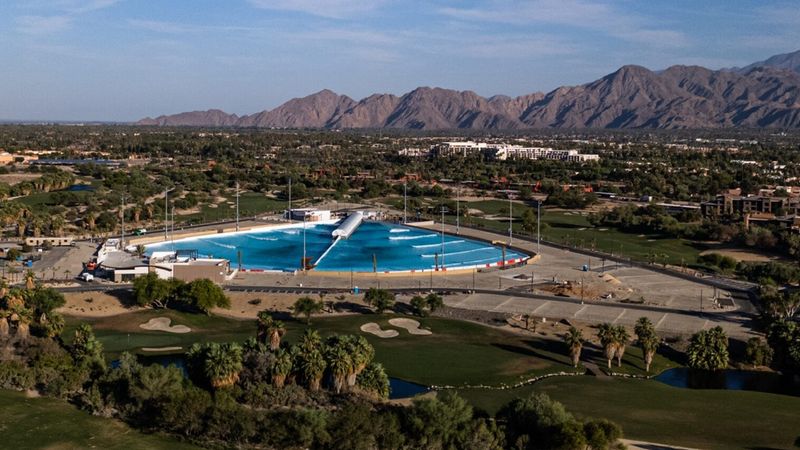
Germany has seven open surf parks in our directory. That is more than any country on Earth except the United States, and more than Brazil, Australia or the United Kingdom. For a country with one short, cold, frequently flat coastline, it is a strange thing to be second at.
The reason is that Germany went a different direction than everyone else. Six of the seven are standing waves: a pump pushes a sheet of water up a shaped floor, the wave holds still, and you ride in place on it. Only one is a lagoon that generates a moving wave you paddle into. Those are close to two different sports sharing a category, and choosing the wrong one is the single most common mistake people make booking a session here.
This guide covers all seven, what each session costs, and the three projects due to change the picture.
Standing wave or lagoon: pick this first
A standing wave is the fastest turn-practice machine ever built. You drop in from the side, the water runs under you continuously, and you work rail-to-rail for as long as you can hold it, usually thirty seconds to a couple of minutes before you fall. There is no paddling, no take-off, no down-the-line section, and no end to the wave. Ridden on a real board with fins, it will make your turns better in a way that ocean sessions take months to.
A lagoon does the opposite. It generates a wave that travels, so you paddle, catch it, stand up and ride it until it closes out, the same sequence you do in the sea.
If you want to practise surfing, either works. If you want to feel like you are surfing, you want the lagoon. Germany has exactly one.
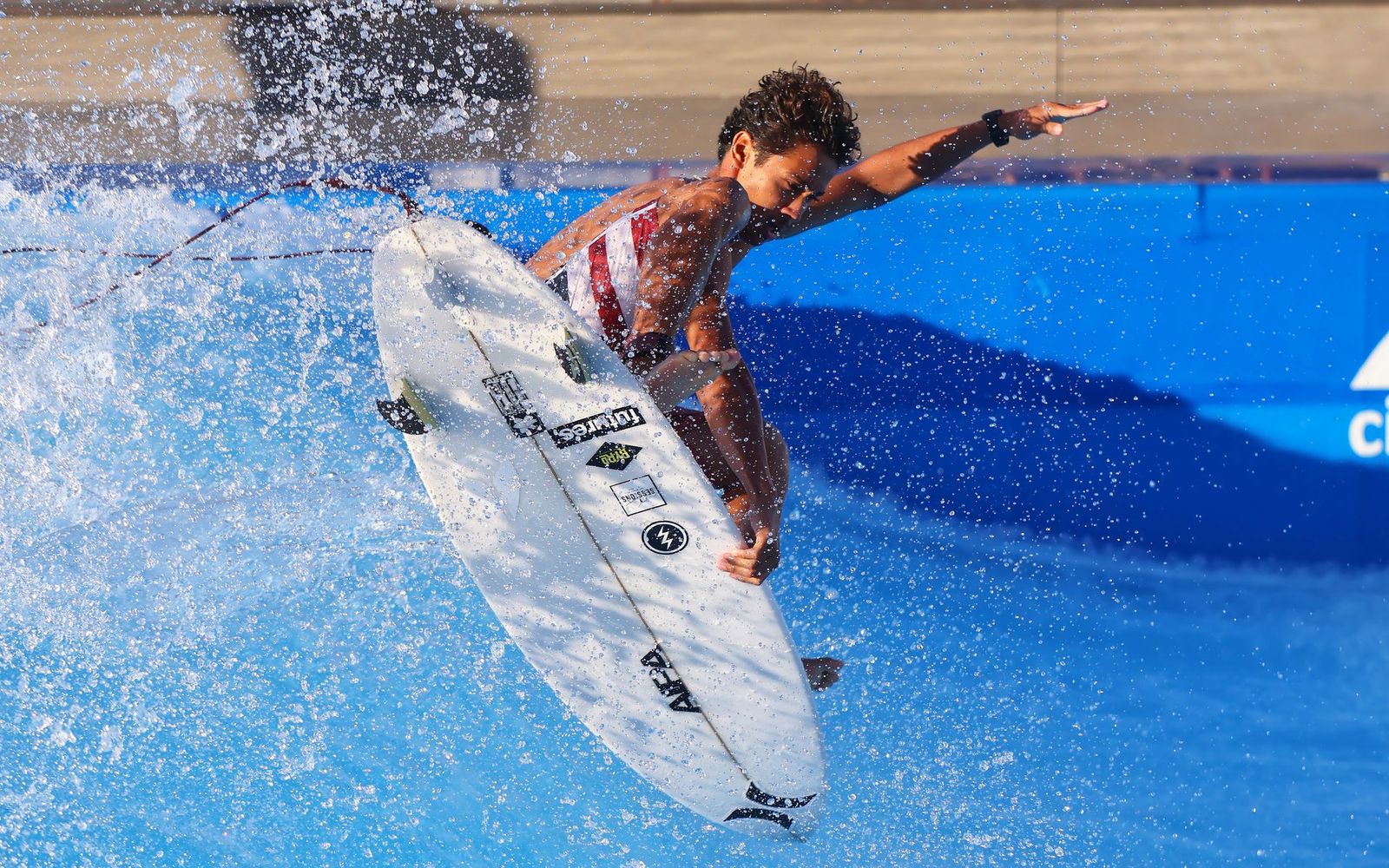
That photo is from Lakeside Surf in Washington State rather than Germany, but it is the same Citywave system that runs at five of the seven German venues, and it shows what the format actually looks like: a real board, real fins, and a wave that stays exactly where it is.
What a session costs
Prices as last checked, for a standard adult session:
- Surf Langenfeld, near Düsseldorf, from about 48 euros
- RheinRiff, Düsseldorf, from about 39.99 euros
- irie surf, Freiburg, from 41 euros
- L&T Hasewelle, Osnabrück, about 49 euros
- Jochen Schweizer Arena, near Munich, about 49.90 euros
- Wellenwerk Berlin, Berlin, about 49.90 euros
- o2 SurfTown MUC, near Munich, from 95 euros
One quirk runs through the Citywave venues: the beginner session often costs more than the advanced one. At Jochen Schweizer, advanced and pro slots are 49.90 euros while adult beginner sessions with instruction are 59.90. At Wellenwerk, beginner sessions are 59.90 with softboard included, while the 49.90 training sessions are for riders who can drop in alone and do not include a board. Compare the tier you will actually book, not the headline rate.
The lagoon: o2 SurfTown MUC
o2 SurfTown MUC opened in summer 2024 in Hallbergmoos, between Munich and the airport, and is Germany's first dedicated surf park. It runs a 180-metre Endless Surf pool: air pressed through 34 caissons to push peeling waves down a lagoon with four surf zones running at once.
Sessions step through six difficulty levels, First Timer through Expert, in two wave modes. A-Frame breaks in the centre and peels both ways, giving peaks for turns, barrels and air sections at the higher settings. Pointbreak runs the full length of the pool alongside the wave generator and produces the longest rides available.
Sessions start from 95 euros for 55 minutes in the water, with Point Break sessions priced higher at 159 euros, and gear rental is not included. Packages of five sessions for 449 euros and ten for 849 euros are open to anyone, while the 25- and 50-session packs (1,999 and 3,799 euros) are for members only. That puts SurfTown at the top end of European pricing, so it rewards intermediates and above who will use every wave of the session more than it rewards a first-timer.
Getting there is the easiest of any park in our directory. Munich Airport is about five miles away, roughly ten minutes by car, which makes a session viable on a long layover. From the city, take the S8 to Hallbergmoos, about thirty minutes from Marienplatz, then the 692 bus for the last leg.
The six standing waves
RheinRiff in Düsseldorf is the one to book if you want to improve. It is a 9,000-square-metre indoor surf hall built around a nine-metre Citywave, billed as the largest facility of its kind in the world, and it was built as a surf venue rather than an attraction bolted onto another business. The four-tier progression runs from complete beginner to advanced, and the whole place is designed for coming back rather than for one novelty visit. Open sessions start around 39.99 euros; coached entry courses run 89.99 for Level 1 and 119.99 for absolute beginners.
Wellenwerk Berlin has been Berlin's only indoor wave since 2019, in Lichtenberg, and it is the best-rounded venue in the country for culture. A surf shop, a working board workshop, a restaurant and a beer garden all sit on the same site. The wave breaks at about 1.6 metres and runs 8.5 metres wide, which the venue claims is the widest in Germany, and water and air are both held around 25 to 27 degrees, so February surfs the same as August. A coach is in every session and video review is available afterwards. Multi-passes stay valid for three years, which is unusually generous.
L&T Hasewelle is the strangest setting of any wave in our directory: a Citywave inside the atrium of the L&T Sporthaus department store in central Osnabrück, with shoppers watching from balcony galleries on the floors above. It has hosted international rapid-surfing competitions. The wave holds a constant 1.5 metres across 7.5 metres, driven by six turbines circulating about 400,000 litres in a closed loop. A 45-minute slot in a group of up to ten costs about 49 euros and works out around eight or nine rides each, with board, wetsuit and helmet included. The gear policy is the tradeoff: unlike other Citywave venues this one issues softboards and requires helmets, which suits a walk-up shopping-centre crowd but means experienced surfers are not on their own hardboard. It also closes Mondays and Wednesdays for maintenance.
Jochen Schweizer Arena in Taufkirchen, south of Munich, opened Germany's first indoor surf wave back in 2017 and still runs it. The Citywave goes 1.2 to 1.4 metres with adjustable shape and speed in water held around 25 degrees. Plan around the surf time: a visit is about 90 minutes with roughly 30 minutes on the wave. The wave sits inside a larger adventure complex with an indoor skydiving tunnel and a high ropes course, which makes it a good call for groups where not everyone wants to surf and a fine session rather than a destination on its own.
irie surf is the newest, open since May 2025 in Freiburg im Breisgau, right by the Messe Freiburg tram stop. It is the only open-air Citywave in the country, and it pitches itself as a meeting place rather than a ticketed attraction, with a surf café, rotating food trucks and a contest calendar. Intermediate and advanced sessions start at 41 euros for 30 minutes on the wave, the beginner course with an hour of theory starts at 73, spectating is free, and multi-session tickets go up to fifty. Check the season before travelling in winter: Citywave's own directory lists Freiburg as seasonal while the venue publishes year-round hours.
Surf Langenfeld is the outlier and the cheapest. It runs a UNIT Surf Pool wave rather than a Citywave, built on a lake next to an existing wakeboard cable park between Düsseldorf and Cologne, and the operator calls it the world's first standing wave on a lake. Medium and Big Surf Sessions are 48 euros for 60 minutes of surf time with a board and coaches included, and wetsuits extra; the beginner Surf Course is 85 euros. Being open lake water, it closes over winter and runs cooler than the heated indoor pools.
If you searched for Munich
Munich has two of Germany's seven parks plus the most famous river wave in Europe, so "Munich wave pool" can mean three completely different things.
o2 SurfTown MUC is the lagoon, in Hallbergmoos by the airport, about 30 minutes north of the centre. Jochen Schweizer Arena is the standing wave, in Taufkirchen to the south. They are on opposite sides of the city, run different technology, and cost roughly 95 euros and 50 euros respectively. They get confused for each other constantly.
The third is the Eisbach, the standing river wave in the Englischer Garten, which is free, permanent, and hard to ride. It is a real part of Munich surf culture, but it is a river wave rather than a surf park, so it does not appear in our directory. If you are in Munich for a weekend and never paddle out on it, go and stand on the bridge anyway.
What is coming
Germany's pipeline is small in number and large in scale.
SURFWRLD, in Werne in the Ruhr region, is the big one. It plans a 242-metre main basin with waves over two metres, plus a covered ten-metre standing wave, on the 17-hectare former Zeche Werne colliery site, using a new wave technology the developer says is being patented. In September 2026 the developer said almost all permits were in hand and construction would start in October or November 2026, with about 20 months of building to an opening in early summer 2028; it expects tickets of 49 to 95 euros. The same basin will serve SCNCWAVE, a hydrodynamic research facility whose members include RWTH Aachen, TH Köln and the University of Duisburg-Essen.
Floating Wave in Hamburg takes the opposite approach: a floating pontoon in the Altona fishing harbour carrying a 12-metre-wide wave up to 1.6 metres, fed with filtered Elbe water and no chlorine. The building application filed in December 2025 had to be resubmitted in June 2026 after a change to Hamburg's building code and is still under review; the project states 2027 for opening, with planned prices of 25 euros for 30 minutes.
Surfgarten Stade, about 40 kilometres west of Hamburg, is a 20,000-square-metre Wavegarden Cove that has spent two years in court. Lower Saxony's higher administrative court found formal defects in the development plan, and the written judgment has since confirmed the project meets the legal requirements on species and climate protection, rejecting the environmental challenge against it. Stade's council approved the amended plan in June 2025, and the initiator aimed to resume building by spring 2026, but in May 2026 the Stade administrative court ruled that the construction stop stays in place. The investor appealed, and on 7 October 2026 Lower Saxony's higher administrative court lifted the stop and restored the building permit, so construction can begin; the court said this decision cannot be challenged, although the main case can still proceed. No opening date has been set.
All three now have park pages in our directory, which is where the specs, sources and open questions on each one live.
Auf Deutsch: Surfparks in Deutschland im Überblick
In Deutschland sind 2026 sieben Surfparks geöffnet. Nur einer davon ist ein Wellenbecken mit laufenden Wellen: o2 SurfTown MUC in Hallbergmoos am Flughafen München, ein Endless-Surf-Pool mit Sessions ab 95 Euro. Die anderen sechs sind stehende Wellen, auf denen man an einer Stelle surft:
- RheinRiff, Düsseldorf: Citywave, Indoor, ab 39,99 Euro
- irie surf, Freiburg: Citywave, Outdoor, ab 41 Euro
- Surf Langenfeld, Langenfeld: UNIT Surf Pool auf einem See, ab 48 Euro
- L&T Hasewelle, Osnabrück: Citywave im Kaufhaus, ab 49 Euro
- Wellenwerk, Berlin: Citywave, Indoor, ab 49,90 Euro
- Jochen Schweizer Arena, Taufkirchen bei München: Citywave, Indoor, ab 49,90 Euro
Geplant sind Floating Wave in Hamburg (Ziel 2027, Baugenehmigung steht noch aus), SURFWRLD in Werne (Eröffnung laut Betreiber im Frühsommer 2028) und Surfgarten Stade bei Hamburg, wo das Oberverwaltungsgericht den Baustopp am 7. Oktober 2026 aufgehoben hat; ein Eröffnungstermin steht noch nicht fest. Die Preise stammen von den Buchungsseiten der Betreiber; alle Details stehen oben auf Englisch.
Good to Know
Germany's seven parks sit in five states, and they cluster in two places. Munich has both o2 SurfTown and the Jochen Schweizer Arena; the Rhineland has RheinRiff and Surf Langenfeld, close enough to combine in a weekend. The other three, Berlin, Osnabrück and Freiburg, are each a long way from everything else, so treat this as a list to pick one from rather than a tour.
Standing waves are almost entirely indoors and climate-controlled, which is why Germany has so many. A Citywave in a Berlin winter runs the same as it does in July, and that reliability is the whole business case in a country three hours from a mediocre coastline. The two outdoor waves, irie surf and Surf Langenfeld, are the two with a season to check.
One number to keep in perspective: Germany has seven open parks to the United States' eleven, but only one of the seven is a lagoon, against six in the US. Counting venues and counting surfable lagoons give very different pictures of the same industry, so check which one a country ranking means before you trust it, including on this site.
For the wider picture, see our guide to Europe's surf parks, the technology comparison if you are still deciding between a standing wave and a lagoon, and the Germany directory page for the live listing of every venue above.