Most people asking what a wave pool costs mean the price of a session, and we answer that in a separate price guide. This is the other question: what does it cost to build one? That number is far bigger, far less public, and it explains almost everything about why some parks open and so many never do.
The short version is that a commercial wave pool is a construction megaproject with a surf machine sitting inside it, and the machine is one of the smaller line items.
The short answer
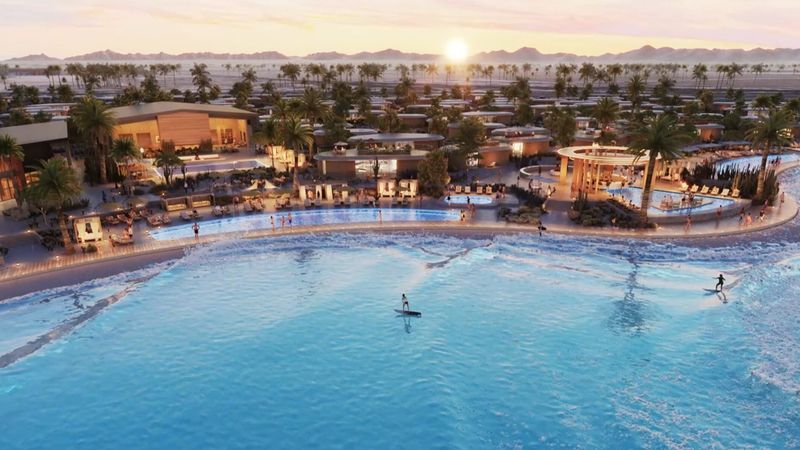
A standalone commercial wave pool with the basic buildings around it starts near 30 million US dollars. Add a hotel and hospitality and you are closer to 100 million. Wrap it in a master-planned real estate community, which is how most large parks now get financed, and the total runs to 150 million and beyond, with the biggest mixed-use developments reported in the 300-to-350 million range. The wave-generating technology itself is usually a small fraction of that, often between 10 and 30 percent.
Where the money actually goes
A surf park budget breaks into a handful of buckets, and the wave is rarely the largest.
- Land. A Wavegarden Cove needs roughly 5 to 6 acres for the pool alone, and most commercial projects want 10 to 15 acres once you add parking, buildings, beach areas, and landscaping. In a market worth building in, the land is often the single most expensive item before anything is poured.
- The lagoon. Excavating, shaping, and lining a multi-acre basin, then engineering the contoured floor that actually forms the wave, is heavy civil construction. This is where the schedule risk lives, and where reclaimed or difficult sites blow past their budgets.
- The wave system. The machine that generates the swell: paddles, pneumatic chambers, a hydrofoil, or a plunger, depending on the technology. We break down how each one works in the technology comparison.
- Water treatment. A pool holding millions of gallons needs filtration, circulation, and sanitation running continuously. It is a real slice of both the build and the operating cost.
- Buildings and grounds. The surf academy, food and beverage, retail, changing rooms, decks, and everything a paying visitor touches.
- Soft costs. Design, engineering, permitting, financing, and contingency, which on a project this complex is not optional.
The machine is the cheaper part
This surprises people. The wave technology is often the line item they assume dominates the budget, and it usually does not.
A standing-wave system, the kind that produces a stationary wave you ride in place, runs roughly 1.5 to 2.5 million dollars for the product itself. A full traveling-wave lagoon is more involved, but even there the hardware is a minority of the spend. Wavegarden publishes a turnkey figure of around 20 million euros, close to 22 million dollars, and that number covers far more than the machine: it includes the lagoon delivery, the wave system, water treatment, the main building, surf school, shop, outdoor areas, service buildings, the booking system, contingency, and the launch itself.
In other words, the thing that makes the wave is bundled into a package where dirt, concrete, and buildings carry most of the weight. A developer cannot make a project cheap by choosing a cheaper wave. The savings, if there are any, come from the land and the civil work.
What each wave system costs
Cost questions usually arrive attached to a vendor rather than in the abstract, so here is what is actually public per system. These are the figures the companies or their developers have put on the record; where nothing is public, that is said plainly rather than filled in.
Wavegarden is the only vendor publishing a headline number. Its turnkey Cove package is quoted at around 20 million euros, roughly 22 million dollars, and that covers the lagoon, wave system, water treatment, main building, surf school, shop, service buildings and launch, not just the machine. With 24 installations it is also the most benchmarked system in the industry.
Endless Surf does not publish pricing. Its systems are sized by caisson count, which is the closest thing to a cost proxy: an ES36 like The Point is a smaller build than the 48-caisson systems specified for PHX Surf and Thermal Beach Club. The Point has been described as a roughly 30 million dollar project.
PerfectSwell from American Wave Machines does not publish pricing either. Its installations range from a 2-acre pool at Waco Surf to the 220-metre pools in Brazil, so the spread is wide and no single figure would be meaningful.
Kelly Slater Wave Co is the outlier at both ends. The original Surf Ranch was reportedly developed for around 30 million dollars, and the system's economics are different from every other vendor's: one foil produces one wave at a time, so the same capital buys far fewer rides per hour.
Standing waves are the cheap entry point by an order of magnitude. A Citywave or UNIT system runs roughly 1.5 to 2.5 million dollars for the product, which is why they keep appearing inside entertainment complexes and water parks rather than as standalone destinations.
The pattern across all of them: the wave is a minority of the budget, and no vendor choice makes a project cheap. Land and civil work decide that.
Real numbers from real parks
Public build costs are rare because most developers never publish them, but a few anchors exist.
- The Kelly Slater Surf Ranch in Lemoore was reportedly developed for around 30 million dollars, which for years set the mental benchmark for a serious wave.
- Lost Shore in Scotland was built for a reported 60 million pounds, roughly 80 million dollars, including its resort elements.
- The Point in Florida, the first Endless Surf lagoon in the US, has been described as a roughly 30 million dollar project.
- The large mixed-use developments, the ones pairing a lagoon with hotels and hundreds of homes, are where figures climb into the hundreds of millions.
Read those as order-of-magnitude markers, not quotes. Every site is different, and a desert build, a reclaimed quarry, and a flat greenfield lot do not cost the same thing.
What it costs to run
Building the pool is only half the problem. Running one is a serious ongoing expense, and energy is the variable that separates the technologies.
Moving that much water takes a lot of power, and vendors claim the efficiency gap between systems is large. The most-quoted figures come from Wavegarden's own energy study, which puts a Cove at around 455 kilowatt-hours to produce 280 shoulder-high waves in an hour against roughly 4,300 kilowatt-hours for a pneumatic system doing the same work, and estimates the difference at 1.3 to 2 million dollars a year for a park generating one to two million waves.
Those numbers get repeated everywhere, including in earlier versions of this guide, usually without the label they deserve: this is a manufacturer comparing its own product against a competing technology, not an independent benchmark. Wavegarden's document sets out its assumptions, and they matter. The comparison is pegged to a specific wave height, ride duration and wave count; the pneumatic comparator is modelled rather than metered at a real park; and what counts as an auxiliary load, along with the electricity price applied, changes the headline saving substantially. Treat it as a vendor estimate with published workings, which is better than most claims in this industry and still not a neutral test.
What is not in dispute is that power is a major operating line, and that some operators chase it directly: The Wave in Bristol runs on an on-site solar array that it says produces more electricity over a year than the park consumes.
On top of power, an operator is paying continuously for water and its treatment, for staffing across coaching, lifeguarding, and hospitality, and for maintenance on a machine that runs thousands of cycles a day. None of it stops when the surfers go home.
Why so many announced parks never open
Once you see the real numbers, the industry's biggest pattern makes sense. For every wave pool that opens, several are announced with confident dates and then stall. The wave technology almost never fails them. Financing, land, and construction do.
That is also why the business model has shifted. Very few operators now build a wave pool as a standalone attraction, because the economics are hard on session revenue alone. Instead the pool is the amenity at the center of a real estate development, and the homes, hotels, and memberships are what actually pay for it. We track that model across the pipeline, from surf communities you can buy into to the full opening tracker, and it is the reason a growing share of new parks are private or residential rather than open to the public.
The bottom line
A wave pool is not a pool with a wave machine bolted on. It is a land deal, a civil-engineering project, and a hospitality business, and the wave itself is one of the smaller checks written along the way. Budget somewhere from 30 million dollars for a lean standalone lagoon to well over 100 million for a resort, and understand that the reason your local project keeps slipping its opening date is almost never the technology. It is everything around it.
If you were after the price of actually surfing one, that is our wave pool session price guide. For live market data across every park, see the industry tracker and the full directory.
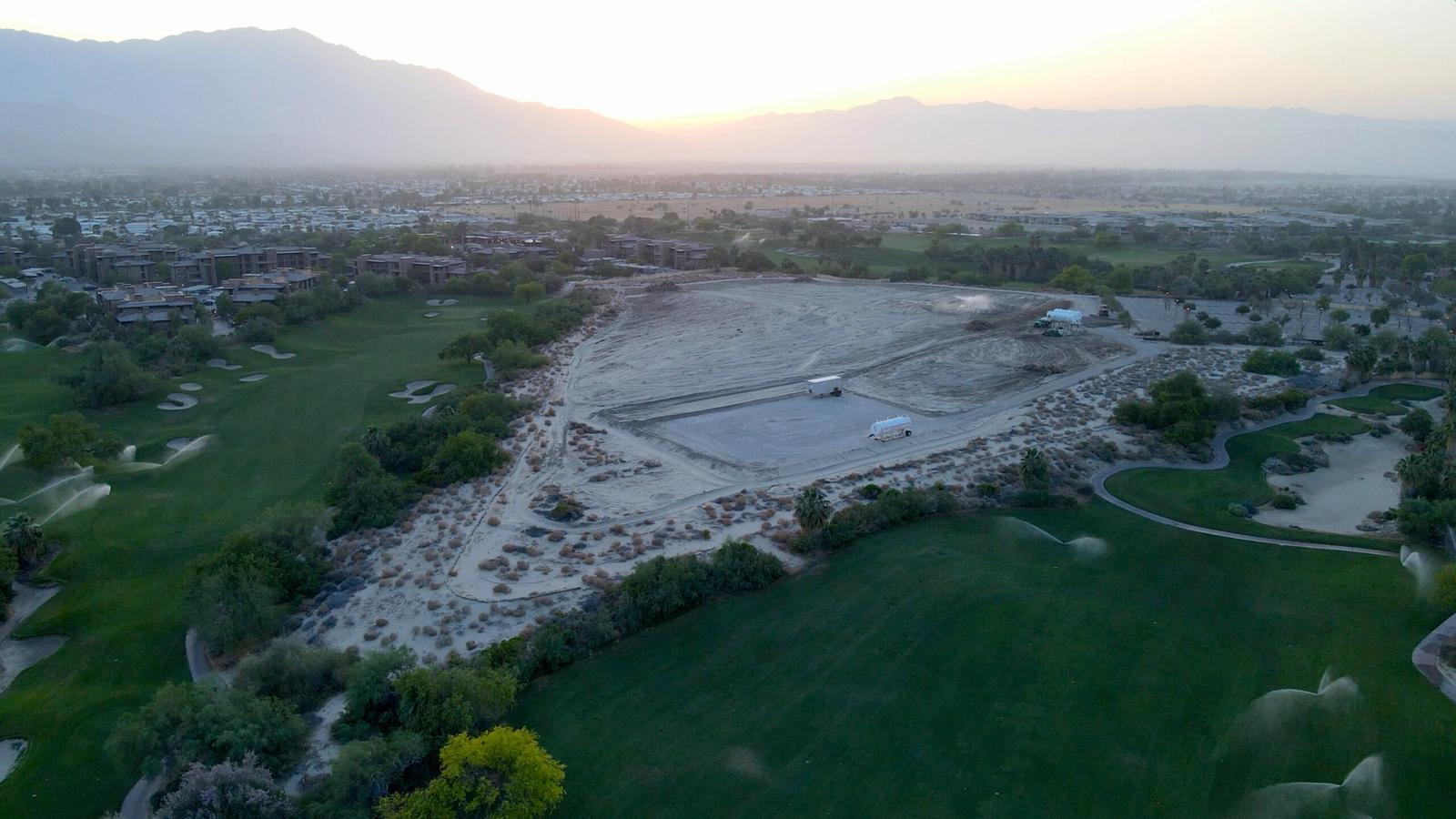
Photo of the DSRT Surf lagoon under construction courtesy of DSRT Surf / Wavegarden.