Canada has plenty of surfers and almost nowhere reliable to put them. Vancouver has 2.8 million people in its metro area and no surf, and the closest real waves mean a ferry crossing and most of a day's driving to Tofino. That gap has made British Columbia one of the most obvious wave pool markets on the continent for years, and one of the slowest to actually produce a pool.
That changed a step in July. A development permit application for the South Britannia surf park and its main building was submitted to the Squamish-Lillooet Regional District, moving the project from land-use approvals into the design and construction paperwork that comes right before shovels.
What was actually filed
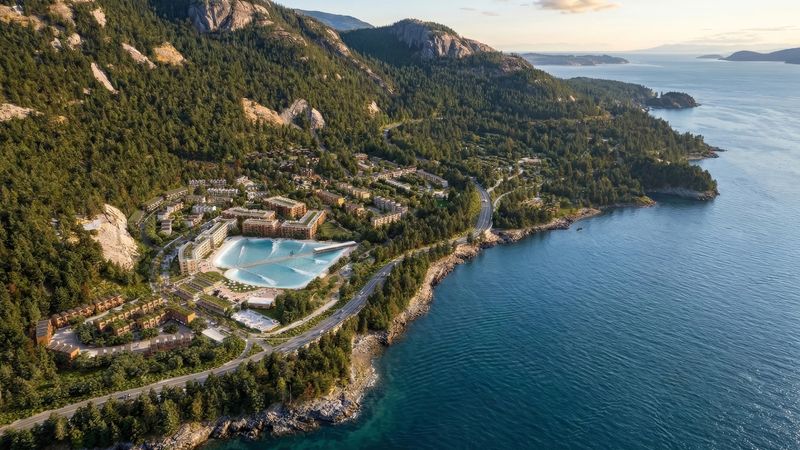
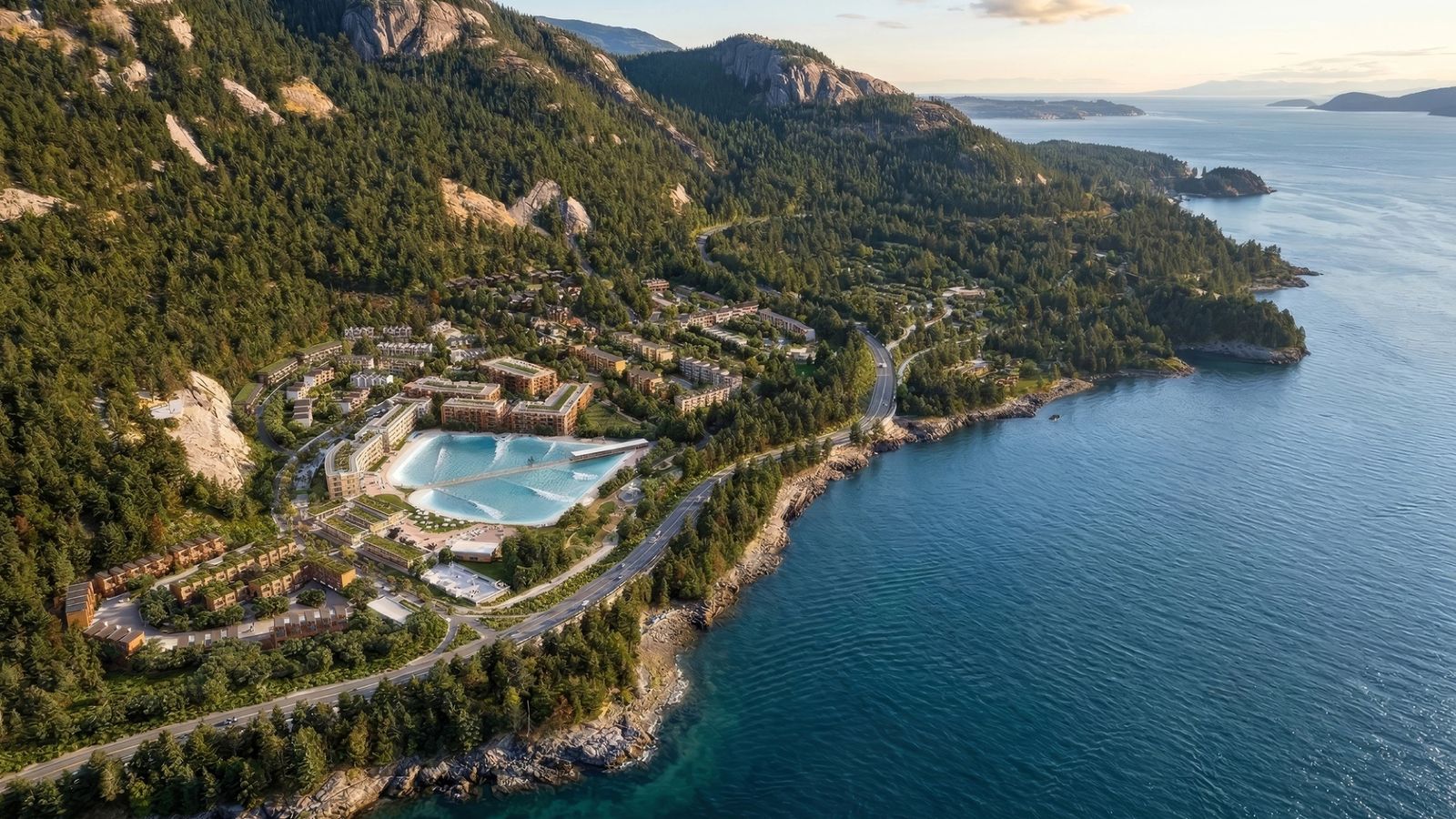
The application covers two things. The first is the wave pool itself: a seven-acre Wavegarden lagoon with a dissipative shoreline, meaning the far end of the pool is shaped to absorb wave energy rather than bounce it back as backwash. The second is the Hub, a 2,800 square metre building holding a surf academy, cafe, bar, restaurant, and retail, wrapped by a 700 square metre outdoor deck looking over the water.
A supplementary permit covering the rest of Phase 1 is planned separately, and that one includes the shoreside surf cabins, wellness facilities, and workforce accommodation. Head of development Tony Petricevic put the goal plainly, saying the team is looking forward to turning the renders into reality and bringing surf to the Sea to Sky in 2029.
The project team is unusually deep for a surf park: MGA on architecture, Hapa Collaborative on landscape, Stantec engineering the lagoon, plus Catalyst, Bluelines Environmental, and Wavegarden itself.
The wave
South Britannia is a Wavegarden Cove, the same platform running at The Wave in Bristol, Lost Shore in Scotland, and Alaia Bay in the Swiss Alps, and the one going into DSRT Surf in California this summer. That is the most useful thing to know about it, because a Cove is a known quantity. It produces up to 1,000 waves an hour across a wide range of settings, from beginner reforms in the shallows to short barrel sections at the top end, and it can run different levels in different parts of the pool at once.
Capacity has been reported at up to 80 surfers at a time, which is high but consistent with the larger Cove installations. Lagoon size is the one number worth watching: earlier filings described six acres, and the July permit application describes seven. Wavegarden has not announced a module count for the site, which is the figure that actually determines wave size and how many surfers the pool can serve at once.
Britannia Beach has done this before
There is a footnote here that most coverage misses. In 2022, Ka'ana Wave Co ran a two-month pop-up surf park on the Tiger Bay development lands at Britannia Beach, demonstrating its CM7 machine to a few hundred surfers, athletes, and developers. It was the first public showing of that technology anywhere.
Ka'ana went on to sign with East Point Reef Club at Bridal Falls, about an hour east of Vancouver, which is currently the only other surf pool project in the province and has been targeting a spring 2026 opening for its pool and thermal spa. So British Columbia has now hosted a temporary wave pool, has a small permanent one in progress, and has a full-size destination lagoon in permitting, all within about 90 minutes of each other. None of them are open yet. You can see the full picture on our Canada page.
The community is the business model
The surf park is the anchor, not the whole plan. South Britannia is a master-planned community on a former quarry site on the shore of Howe Sound, and the approved build-out runs to roughly 1,050 homes: about 900 market units plus 150 rental and non-market affordable apartments, alongside hotels, waterfront lodging, cabins, glamping, retail, and a transit hub. The official phasing puts the surf park, beach house, cabins, and trails in Phase One from 2026 to 2029, homes and the surf hotel in Phase Two from 2030, and full build-out around 2035.
That structure is now the dominant way surf parks get financed in North America. The pool is what makes the real estate distinctive, and the real estate is what pays for the pool. We track the same pattern at The Desperado in Waco, Veranda West in Utah, and DSRT Surf in the California desert.
Read the date carefully
A permit application is real progress, and it is not a construction start. Worth keeping in mind: this project was introduced in 2019, filings from a couple of years ago pointed at waves by 2027, and the current target is 2029. The site is a reclaimed quarry beside a rail line and a highway on a steep coastal shelf, which is exactly the kind of ground that generates engineering surprises.
Update, 11 September 2026: one of those has now happened. The Globe and Mail reported on 8 September that site work began in late August, and that the surf park is expected to open in 2029. That moves this from a paper filing to a project with machines on the ground, which is the single most meaningful signal on this list.
That report describes the lagoon as six acres, the earlier figure, rather than the seven in the July permit. The discrepancy is still unresolved.
Two things are still outstanding. Whether the supplementary Phase 1 permit gets submitted, and whether Wavegarden confirms a module count and a manufacturing slot. Get those and 2029 starts looking like a schedule rather than an ambition.
This piece covers the July 2026 permit filing. For current status, wave specs, access, and the opening date as it moves, our South Britannia Surf Park profile is the page we keep updated. For everything else in the pipeline worldwide, see the opening tracker and the full directory.
Rendering courtesy of South Britannia / Tiger Bay Development.