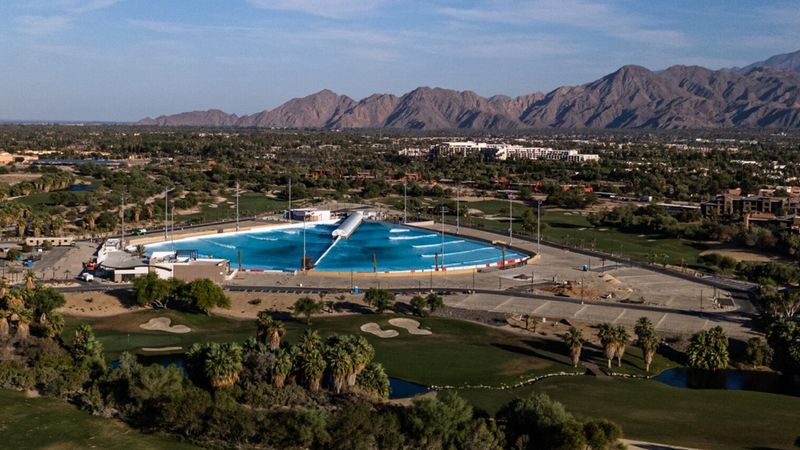
Asia has five open wave pools and no two are alike. Three are surf lagoons, where the wave travels and you paddle into it. Two are standing waves, where a sheet of water is held in place and you ride without moving. The first kind is practice for the ocean. The second is practice for turns.
That distinction is the one that should decide your trip, and it happens to line up with cost. The lagoons run $59 to $82 a session before entry fees. The standing waves run $39 to $70 and sit inside cities.
One thing to know before any of it: check what a ticket includes. At Wave Park and Surf Stadium Japan the surf ticket covers entry, while board and wetsuit hire is extra at Wave Park and at Riyue Bay.
The three surf lagoons
Wave Park, South Korea
The benchmark for scale in the region. Wave Park opened in October 2020 in Siheung, about 30 minutes from Incheon airport and an hour from central Seoul, and Wavegarden described it at launch as the world's largest Wavegarden Cove, with 56 modules. It sits beside the Mio Costa water park on the Geobukseom waterfront, built with Daewon Plus Group.
Free Surfing is KRW 80,000 an hour, about $59, on the beginner and intermediate settings, and KRW 110,000, about $82, on advanced. Lessons, taught in Korean, run KRW 119,000 to 130,000. Surf bookings include showers, changing rooms and the Mio Costa water park when it is open; boards and wetsuits are extra, from KRW 9,000 and 10,000. The 2026 season runs from late April to 31 October.
The booking site is primarily in Korean, which adds a step for international visitors, though resellers and guides bridge it. Weekend slots go quickly and summer crowds are substantial, because this runs as a full leisure destination rather than a surf-only facility.
Best for: Anyone near Seoul with a free day. The transit logistics are the best in Asia and it works as a mainstream day out, not only a surf session.
Surf Stadium Japan, Shizuoka
An Olympic pedigree in an unlikely place. Surf Stadium Japan opened in 2021 in Shizunami on Shizuoka's Pacific coast, and celebrated its fifth anniversary in August 2026. The PerfectSwell basin was completed in time for Olympic team training ahead of the Tokyo Games.
There are two kinds of ticket, both including entry: a surf session ticket for a set time, and an entry ticket for watching and playing in the shallow water. A session is 9 waves. On weekdays Nose Ride, a gentle wave for mid-lengths and longboards rated beginner to intermediate, and Malibu cost ¥11,000; Public is ¥12,100 and Advance ¥14,300, all with tax and entry included and ¥1,100 more at weekends. Boards and wetsuits rent separately, coaching is a ¥5,500 add-on, and bookings open about two months ahead.
The park has faced reported commercial difficulty since opening and schedules can run sparser than at Western pools, so confirm operating days before travelling any distance for it.
Best for: Surfers already planning a Japan trip who want a confirmed, Olympic-tested wave. Check the booking calendar before committing.
Riyue Bay, China
The newest lagoon in Asia. Riyue Bay opened on 11 November 2025 in Wanning on Hainan Island, beside the natural Riyue Bay surf break. The PerfectSwell pool sits on a campus of more than 10 hectares with two hotels, developed by China Tourism Group.
The resort's own prices could not be checked. Booking agent Surfway Hainan lists 55-minute high-season sessions at CNY 458 for complete beginners, 388 for experienced beginners (about $58), 408 for intermediate, 528 for advanced and 580 for pro, with board and wetsuit rental extra. Even the top tier sits below what most Western parks charge for a comparable slot.
The obstacle is logistics rather than money. It is roughly 14 hours from the US East Coast to Hong Kong plus another hour to Hainan, Wanning has limited public transport, and English-language booking is not confirmed. Resolve that before planning around it.
Best for: Budget-conscious surfers already travelling in China or Southeast Asia, rather than as an add-on to a trip from the US or Europe.
The two standing waves
Both sit in or near a major city. Neither teaches you to catch a wave. They teach you to ride one you are already standing on, which is a narrower skill and a useful one between ocean trips.
citywave Tokyo Sakaimachi, Ibaraki
citywave Tokyo Sakaimachi runs a Citywave standing wave at JPY 10,780 an hour, about $70. Board, wetsuit and helmet are included, which makes it the simplest way to surf a wave pool near Tokyo, though it is about 35 miles by road from Tokyo Station.
The context that matters: Japan's only lagoon, Surf Stadium, is a few hours southwest in Shizuoka and runs an irregular schedule. For anyone in the Tokyo metro wanting reliable water time, this is the practical option rather than the compromise it looks like on paper.
Best for: Tokyo-based surfers drilling turns between ocean weekends.
TRIFECTA Surf Club, Singapore
TRIFECTA Surf Club runs a Citywave at Somerset, near Orchard Road. First-timers must take a 45-minute Surf Orientation Class (SGD 50 to 60); after that, open sessions and classes are SGD 100 off-peak and SGD 120 at peak, about $78 to $94. It is the only park on this list in a country with no surf at all, which is precisely why it exists.
Best for: A stopover session, and for Singapore residents who would otherwise fly to Bali to stand on a board.
What is coming
Three projects are on the board. PerfectSwell Shima in Mie Prefecture would be Japan's second traveling-wave lagoon and its developer has pointed at summer 2026, a window now closing with no opening announced. Treat the date as unconfirmed until sessions go on sale. WAVEPARK BIWAKO, on Lake Biwa in Kusatsu, Shiga, is planned by JPF for 2029; JPF was chosen as preferred negotiator for the site in 2024, and a land agreement and building approvals have not been announced. In China, CTG Investment acquired the first-phase land for Guangzhou CTG Zhulang Super Park in August 2026 for a surf pool of about 20,000 square metres; no wave vendor or opening date has been announced.
Which one
If you are in Seoul, Wave Park, and budget for the entry pass on top. If you are already crossing Japan, Surf Stadium for the wave and citywave Tokyo for the convenience, and check Surf Stadium's calendar first. If cost decides it, Riyue Bay and Wave Park are the cheapest lagoon hours in Asia, both around $58 to $59.
If you are choosing between the machines rather than the destinations, our PerfectSwell and Wavegarden Cove pages list every installation each vendor runs, and the price guide puts the 41 open parks with checkable prices on one list.
Photo of Wave Park courtesy of Wavegarden.