Wave Pool Technology in 2026: A Beginner’s Guide
Artificial wave pools are no longer a novelty. Ten years ago, the question was whether a machine could make a surfable wave at all. In 2026, the better question is: what kind of wave do you want?
That is because “wave pool technology” is not one thing. Different companies use very different systems to move water, shape waves, control frequency, and serve different types of surfers. Some parks are built for high-volume beginner lessons. Some are built for intermediate progression. A few are designed around elite, bucket-list waves that feel closer to a private golf club than a public waterpark.
For surfers, the technology matters because it affects almost everything: ride length, wave count, difficulty, crowd flow, price, and whether you are getting soft whitewater reps or a real barrel section.
The Two Things Every Wave Pool Has to Solve
Every surf park has two jobs.
First, it has to create energy. In the ocean, that energy comes from wind blowing across open water. In a wave pool, it comes from a machine: air chambers, moving foils, paddles, plungers, hydraulic boards, or other mechanical systems.
Second, it has to shape that energy into a breaking wave. That part usually comes from the pool floor, also called bathymetry. Just like an ocean reef or sandbar, the bottom contour determines whether a swell turns into a soft beginner roller, an open-faced wall, an A-frame, or a hollow barrel.
The best wave pools are not just powerful. They are controlled. They can repeat waves, adjust settings, and create progression zones for different skill levels.
Wavegarden Cove: The Commercial Workhorse
The most common name you will see in modern surf parks is Wavegarden, especially its Cove technology.
Wavegarden is a Spanish company that has become one of the dominant players in full-size public surf lagoons. Its Cove system uses a modular electromechanical wave generator to create a high number of waves in a relatively compact lagoon. The appeal is simple: it can serve beginners, intermediates, and advanced surfers in the same facility, often at the same time.
This is why Wavegarden has become so popular with resort-style surf parks. It is not just chasing the single best wave. It is chasing a full business model: lessons, memberships, advanced sessions, events, food and beverage, tourism, and real estate.
Examples of Wavegarden-powered parks include The Wave Bristol, URBNSURF Melbourne, URBNSURF Sydney, Alaïa Bay Switzerland, Wave Park South Korea, Lost Shore Surf Resort, and newer arrivals led by Beyond the Club in São Paulo, the largest Cove built to date, and Surfland Brasil in Garopaba.
For the average surfer, Wavegarden is usually the most approachable version of the modern wave pool. You can book a session, pick a level, and expect consistent waves without needing to be a pro or know somebody with an invite.
Best for: high-volume public surf parks, beginner-to-advanced progression, travel-friendly sessions, families, and operators who need consistent throughput.
Pneumatic Systems: Air-Powered, Programmable, and Growing Fast
The other major category is pneumatic wave technology. Instead of pulling a foil through the water, these systems use air pressure inside chambers or caissons to displace water and send waves across the pool.
The big idea is control. By changing the timing, pressure, and firing sequence of the air chambers, operators can create different wave shapes: rights, lefts, A-frames, beginner waves, performance sections, and sometimes barrel settings.
The major companies in this category include American Wave Machines, Endless Surf, and SurfLoch.
American Wave Machines / PerfectSwell
American Wave Machines is the company behind PerfectSwell, the technology made famous at Waco Surf in Texas. PerfectSwell uses computer-controlled air systems to create a variety of waves. Waco was important because it showed that a public wave pool could produce punchy, high-performance waves that did not feel like a soft waterpark roller.
PerfectSwell parks tend to appeal to surfers who want variety and progression. They can be set up for beginners, but the brand’s reputation is heavily tied to more performance-oriented waves: air sections, turns, barrels, and repeatable clips. The footprint keeps growing: Boa Vista Village and São Paulo Surf Club in Brazil, Surf Stadium Japan, and China's new Riyue Bay resort all run PerfectSwell.
Best for: surfers who want variety, performance sections, and a more “sessionable” public park experience.
Endless Surf
Endless Surf, owned by WhiteWater, is another pneumatic system gaining attention. It uses a line of caissons to create adjustable waves and is designed around commercial surf park development. The technology powers O2 SURFTOWN MUC near Munich, one of Europe’s most important new surf parks. The system also powers the Aquarabia water park at Qiddiya in Saudi Arabia, and its first American lagoon opens this fall at The Point Surf Park in Florida.
Endless Surf is positioned as a flexible, scalable option for developers who want a modern surf lagoon that can handle multiple user groups. It sits in a similar market conversation as Wavegarden and PerfectSwell: not just “can it make a wave?” but “can it run a profitable, high-throughput surf park?”
Best for: modern public surf parks, adjustable sessions, and operators who want a flexible pneumatic system.
SurfLoch
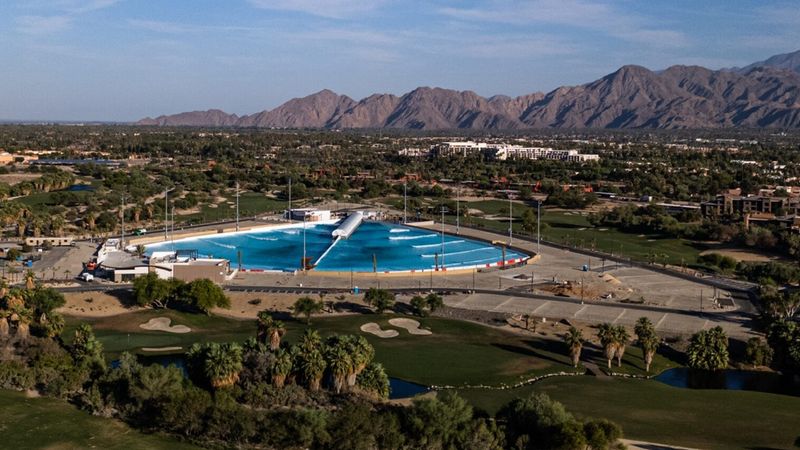
SurfLoch comes from Tom Lochtefeld, one of the original pioneers of artificial surf. SurfLoch technology powers Palm Springs Surf Club, one of the most important California surf parks because it proved that an old waterpark-style site could be reworked into a serious surf destination.
SurfLoch uses pneumatic wave generation and emphasizes custom wave shapes. Palm Springs Surf Club is known for offering a wide menu of waves, from beginner-friendly settings to heavier slab-style waves. The company’s newer WaveBender concept is focused on creating more ocean-like, directed waves with strong control over timing and form. SurfLoch also powers RIF010, the urban surf pool in the center of Rotterdam.
Best for: customizable surf menus, resort-style parks, and advanced settings alongside beginner options.
Kelly Slater Wave Company: The Premium Hydrofoil Wave
Then there is Kelly Slater Wave Company, which sits in its own category.
The Surf Ranch in Lemoore, California uses a hydrofoil system. A large underwater foil is pulled down a long track, displacing water and creating a perfectly peeling wave that runs along the basin. Instead of hundreds of shorter rides per hour, the Surf Ranch model is built around fewer, longer, higher-quality waves.
This is the technology that changed the conversation around artificial waves. When the first Surf Ranch clips appeared, surfers stopped asking whether a machine-made wave could be good. The answer was obviously yes. The problem was access.
Surf Ranch is not like most public surf parks. It is expensive, limited, and heavily associated with private rentals, WSL events, corporate experiences, and bucket-list surf trips. The wave quality is elite, but the business model is not built around casual walk-up sessions.
Kelly Slater Wave Company technology is also connected to newer premium projects, including Surf Abu Dhabi and the private Austin Surf Club build in Texas.
Best for: elite wave quality, long rides, private experiences, pro training, and luxury surf destinations.
Surf Lakes: The Giant Plunger Concept
Surf Lakes takes a completely different approach.
Instead of generating a wave from one side of a pool, Surf Lakes uses a large central wave device (basically a giant plunger) that moves up and down in the middle of a lake. That motion sends circular swell lines outward toward multiple reef sections around the lake.
The promise is huge: one central movement can create multiple waves for different skill levels at the same time. In theory, beginners, longboarders, intermediate surfers, and advanced surfers can all be riding different breaks from the same pulse of energy.
It is one of the most visually memorable technologies in the industry because the machine looks like something from an oil field or a sci-fi movie. The upside is multi-break variety. The downside is that Surf Lakes has not become as widely deployed commercially as Wavegarden or pneumatic systems. It remains one of the most interesting technologies to watch, but not yet the default choice for most surf park developers.
Best for: multi-break concepts, large land sites, spectacle, and parks that want several different wave zones from one central system.
Swell MFG: Arizona’s New Mechanical Wave System
A newer name in the space is Swell MFG, the technology behind Revel Surf in Mesa, Arizona.
Swell MFG uses a mechanical system of individually controlled waveboards or levers to push water and create surfable waves over shaped bathymetry. The result is a more compact, punchy lagoon with a split-peak setup and different wave settings.
This technology is newer and less proven globally than Wavegarden, PerfectSwell, or Kelly Slater Wave Company, but that is also what makes it interesting. Revel Surf is one of the first real public tests of whether Swell MFG can become a serious player in the next generation of surf parks. The same team broke ground on Cannon Beach, a SwellMFG-anchored resort in McKinney, Texas, in late 2025.
The waves are generally shorter than something like Surf Ranch, but the appeal is accessibility, variety, and a facility that can fit into a mixed-use entertainment development.
Best for: compact surf lagoons, split peaks, Arizona-style mixed-use surf developments, and parks that want something different from the big established systems.
Standing Waves: Not the Same Thing, But Still Important
Standing wave systems are often grouped into the wave pool conversation, but they are not the same as traveling surf lagoons.
A traveling wave moves across a pool and breaks like an ocean wave. A standing wave stays in one place while water rushes underneath the surfer, more like a river wave. You are surfing continuously on moving water rather than paddling into a wave that travels across the basin.
Major standing wave companies include Citywave, UNIT Surf Pool, FlowRider, and other rapid-wave systems. These are popular in urban venues, malls, cruise ships, waterparks, training centers, and smaller entertainment projects because they need far less land than a full surf lagoon.
Standing waves are great for repetition. You can practice balance, turns, rail control, and basic surf movement without waiting for sets. But they do not fully replicate the paddle-in, takeoff, trim, and down-the-line experience of a traveling wave pool. In the United States you can ride Citywave at The LineUp at Wai Kai on Oahu and at Lakeside Surf in Washington, and ADG's new EpicSurf format debuted at Heroes Paradise in Florida in June 2026.
That is why some modern parks include both. Revel Surf, for example, combines a traveling surf lagoon with a standing rapid wave, giving visitors two different kinds of artificial surf in one development.
Best for: compact venues, beginner practice, urban entertainment, rapid progression, and add-on attractions next to larger surf lagoons.
How the Industry Has Progressed
The first era of artificial waves was mostly waterpark waves. They were fun, but not serious surf. They created whitewater, not real surf lines.
The second era proved that inland surfing could be real. Early Wavegarden projects and other first-generation lagoons showed that surfers would travel and pay for man-made waves, even if the technology still had limitations.
The third era was the performance breakthrough. Kelly Slater’s Surf Ranch showed the world that a machine could create a truly world-class wave. Waco Surf showed that a public-facing park could generate punchy, high-performance air sections and barrels. Wavegarden Cove showed that large public parks could deliver reliable wave counts for many skill levels.
The fourth era is where we are now: the business-model era. Developers are not just asking which machine makes the best wave. They are asking which technology fits the land, climate, budget, operating costs, target surfer, hotel plan, membership model, and surrounding real estate.
That is why the industry is splitting into categories. Wavegarden is popular for full-scale destination parks. Pneumatic systems are gaining ground because of their flexibility and programmability. Kelly Slater Wave Company remains the premium, high-end benchmark. Surf Lakes, Swell MFG, Webber Wave Pools, and other concepts are pushing alternate designs. Standing waves are spreading because they are smaller, easier to place, and useful for training.
Which Wave Pool Technology Is Most Popular?
For full-size public surf parks, Wavegarden Cove is probably the most widely recognized and broadly deployed modern technology. It has multiple operating parks across Europe, Australia, Asia, and South America, plus a large pipeline of projects.
Pneumatic systems are the fastest-rising category. American Wave Machines, Endless Surf, and SurfLoch all use air-powered systems in different ways, and they are especially appealing because they can create multiple wave types through software and chamber timing.
Kelly Slater Wave Company is the prestige option. It is not the most accessible or highest-throughput model, but it is still the technology people point to when they talk about the best artificial wave ever made.
Standing waves may end up being the most common artificial surf experience overall, simply because they can fit in smaller urban spaces. But they are a different product than a full surf lagoon.
What This Means for You
If you are choosing a surf park, do not just look at the name of the park. Look at the technology and session format.
If you are a beginner, you want consistency, easy takeoffs, forgiving foam, and lots of reps. Wavegarden beginner zones, pneumatic beginner settings, and standing waves can all work well.
If you are intermediate, you want a wave that gives you time to trim, pump, and start doing real turns. Look for open-face intermediate sessions, not just whitewater lessons.
If you are advanced, you care about speed, power, barrel sections, air sections, and whether the wave lets you surf vertically. That is where the differences between Surf Ranch, PerfectSwell, SurfLoch, Wavegarden advanced settings, and Swell MFG become more important.
The main thing to remember is that wave pools are not replacing the ocean. They are creating a new category of surfing: predictable, bookable, repeatable waves built around progression.
And in 2026, the technology behind those waves is finally mature enough that surfers have real choices.