Surf Park Summit ran September 1 to 3 in Virginia Beach, and its organiser Surf Park Central put attendance at around 400, the largest the industry has gathered. Developers, investors, operators, and wave technology companies spent three days on what is becoming the real subject of this business: not whether you can build a wave, but whether the thing around it works.
The same emphasis showed up earlier in the year. Bisnow, a commercial real estate publisher, ran its first Surf Park Real Estate Conference in Orange County on July 23, and its published program lists four panels on asset class, financing, delivery, and operations. Two events, two rooms full of capital, and the wave treated as the anchor tenant.
Day one ran inside a working surf park
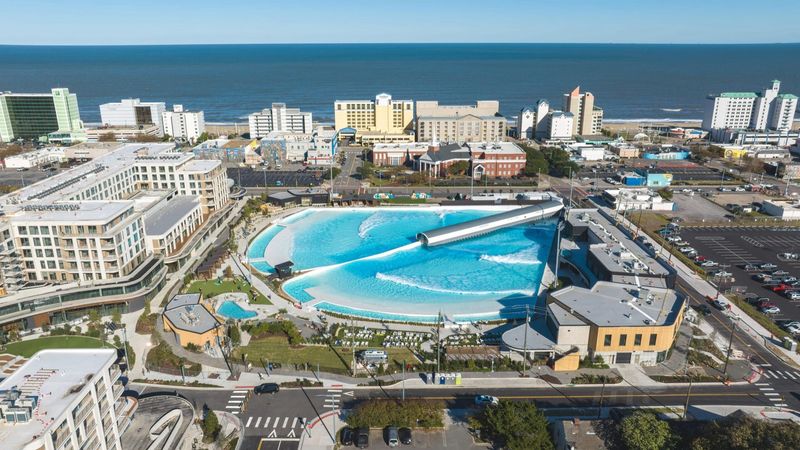
For the second year running, the Summit opened at Atlantic Park, the Wavegarden Cove on the Virginia Beach oceanfront. Attendees toured the lagoon along with the hotel, concert venue, apartment building and 110,000 square feet of retail and dining built around it, with the project's own leaders walking through what has changed since opening and what the development has meant for the surrounding blocks.
Holding the first day inside an operating mixed-use surf park rather than a ballroom is the clearest statement of what the event is about. Atlantic Park is the closest thing the United States has to a finished version of the model everyone else is financing.
The day also included a developer workshop from architect Chris Ryan on "third places", the idea that a destination has to be somewhere people go that is neither home nor work, and the Chlorine Clash invitational, which brings a strong field of surfers to the lagoon.
Operators agreed on helmets
Surf park operators from Australia, Europe, the Middle East, South America, and the United States held a closed-door meeting on day one. The outcome was a shared safety push: making helmets freely available to anyone who wants one, and mandatory in some situations.
This has not been reported anywhere else and it deserves more attention than it has had. Wave pools produce repeatable waves over a fixed bottom, which makes board contact and collisions predictable rather than freak occurrences. An industry agreeing on a standard before an incident forces one is the right order to do it in.
The first real utilization data
Surf Park Central CEO Jess Ponting opened day two with 2026 consumer trends survey results and something the industry has not had before: aggregated utilization data drawn from real parks, compiled in partnership with Flowstate.
It covers how full parks actually are, how that moves across the seasons, and how it varies by day of the week and time of day across different types of customer. Every feasibility study and visitor projection in this business has so far been built on modelling. Having measurement to check it against is a real step forward, and Ponting said the intention is regular updates through the year rather than a one-off.
Day two also included the launch of the Surf Conservation Fund, which gives surf park users a way to contribute to ocean surf ecosystem conservation.
Cole Cannon on building where nobody has
The day two keynote came from Cole Cannon, who built Revel Surf in Mesa, Arizona and is now developing Cannon Beach in McKinney, Texas. He spoke about the difficulty of developing a surf destination in a market with no precedent for one, and gave an update on the Texas project.
That project had news of its own the same fortnight. McKinney released nearly $21 million in land-sale proceeds toward it on September 15.
Four projects pitched live
Surf Park Sharks, the Summit's pitch contest, was won by Hidden Lake Surf Resort in Buckeye, Arizona. The plan puts a 12.5-acre Endless Surf lagoon on 120 acres built around an existing 60-acre river-fed lake, with a resort hotel, beach club, marina, villas, casitas and glamping. Managing partner Drew Boyles, a former mayor of El Segundo, also took Developer of the Year. The land is owned outright and the approvals are in place, which is a large part of why it won.
The other three finalists were:
- Ida Surf Park in Boise, Idaho, from Brandon Watson. A 40-acre Wavegarden Cove district using an RV park rather than a hotel for lodging, targeting 2029.
- PA National Surfing Club at Montage Mountain near Scranton, Pennsylvania, from Daniel P. McDonough. A Cove added to an existing four-season ski resort, pitched on the 30 million people within driving range, with design through 2026 and a phased 2028 opening.
- Cleora near Salida, Colorado, from developer True North. A 3D-printed housing community on the Arkansas River whose master plan has added a full-scale standing wave on a block off Main Street.
The semifinalist field is worth knowing too, because it shows the range: Molaya Bay in Panama, pairing a 2.8-acre Endless Surf lagoon with a 111-key Marriott Tribute Portfolio hotel; Smoky Mountain Surf Co, an indoor Citywave planned for a 250-acre development in Knoxville; Boston Surf Supply, an indoor retrofit into an existing urban building; and The Knot in Gainesville, a standing wave inside an action sports district near the University of Florida.
Sharks is open to projects at the capital-raising stage, so these are early by design. None of the four finalists other than Hidden Lake has a page in our directory yet, which is a question of evidence rather than doubt: we add a park once there is land, an approval, a filing, or a date someone is publicly accountable for. All four are on the watch list.
Day three and the competition question
The final day opened with the World Surf League's Graham Stapelberg and Dave Prodan in conversation with Stab co-founder Sam McIntosh on how surf parks, professional competition and surf media fit together. With the Wavepool Surf Tour expanding and more venues capable of holding a contest, that relationship is one of the more interesting open questions in the sport.
The rest of day three ran on capital, development, operations, technology and real estate.
The 2026 awards
- Leadership: Shaun Hutchinson
- Sustainability: DSRT Surf
- Community Impact: Lost Shore Surf Resort
- Best Surf Park Event: URBNSURF Sydney with Stab
- Developer of the Year: Drew Boyles, Hidden Lake
Four of the five went to parks or people behind parks we track, across three continents, which says something about how small the operating end of this industry still is.
Good to Know
Surf Park Central counted 16 openings worldwide in the past 24 months. Our own directory has 85 parks, 46 of them open and 38 somewhere in the pipeline, with 10 open in the United States and 19 more coming.
If you are planning a trip rather than a development, the helmet agreement is the part most likely to reach you. If your local park starts offering them, that is an industry decision rather than one venue reacting to something.
The pipeline lives in the opening tracker and the residential side in real estate.