For three months, Newport Beach had an approved plan for what its developer billed as "the largest Wavegarden artificial wave park globally." Then a petition drive undid the key part of it, and the project has been in limbo since.
What was approved
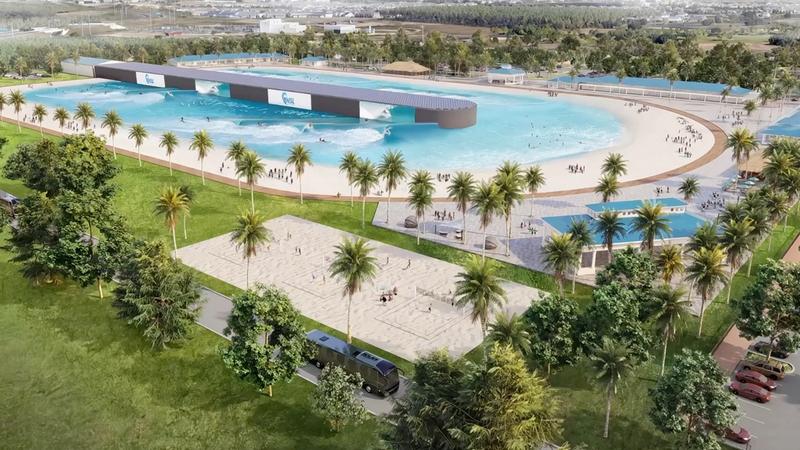
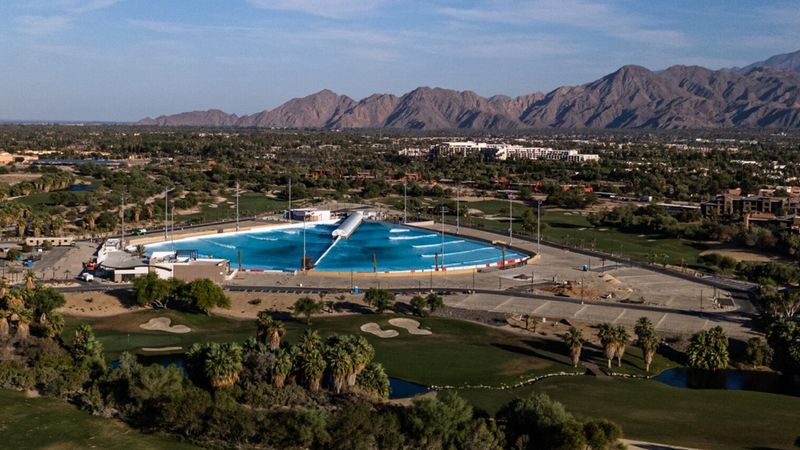
Back Bay Barrels LLC, a company started by Adam Cleary, proposed Snug Harbor Surf Park for the privately owned part of the Newport Beach Golf Course at 3100 Irvine Avenue, replacing the driving range, putting green, pro shop, restaurant and three golf holes with a 5.06-acre Wavegarden Cove lagoon. Cleary has said he asked Wavegarden for 66 modules, above what he described as its standard and biggest configuration of 62, which is the count Surf Farm in Australia chose. He has been blunt about why: "Because we're American, and we want the biggest and best." On acreage the math is less generous. DSRT Surf in Palm Desert already runs a 5.5-acre Cove, larger than what's planned here, so the "biggest in the world" claim rests on module count rather than pool size.
The plan pairs the lagoon with a surf academy, surf shop, coffee shop, and restaurant and bar, aiming for up to 1,000 waves an hour, 25 types of waves and up to 72 surfers at a time. On October 28, 2025, the City Council approved the project, and as part of that approval adopted Resolution No. 2025-71, a General Plan Amendment that raised the site's allowable development from 20,000 to 59,772 square feet.
Then a petition drive reversed it
Save Newport Beach Golf Course, a resident opposition group, gathered more than 6,100 valid signatures on a referendum petition, enough to force the council to either put the issue on a ballot or undo its earlier vote. Rather than spend up to $143,000 on an election, the council voted 6-0, with one member recused, to repeal Resolution 2025-71 at its January 27, 2026 meeting. Benny Hallock, the group's volunteer chair, said at a council meeting that "wave pools are trendy, shiny objects that fail under financial reliability."
The repeal doesn't zero out the project. It reinstated the site's previous 20,000-square-foot development limit, and Councilmember Erik Weigand said a project could still be built for outdoor recreation if it stays within that limit. The developer declined to comment on whether it would pursue that option, Picket Fence Media reported.
Now it's in court
By the end of April 2026, Save Newport Beach Golf Course had sued the city. The lawsuit alleges that City Manager Seimone Jurjis is still trying to move the project forward, and asks a judge to immediately block development of the surf park and any demolition of the golf course. Under the city's reading, the group's lawyers wrote, a developer "could still demolish the driving range, the restaurant, and three holes of the golf course for a surf park project before the conditional use permit expires in October 2027."
The city disputes that. "The referendum only contested the General Plan Amendment (GPA), and the City Council only rescinded that specific amendment," city spokesperson Georgia Rios wrote in a statement, adding that "other approvals were outside the scope of the referendum and were not revoked."
The real estate case against it
There's a reason this fight is about more than surfing. The County of Orange owns the golf course's back nine, the golf course lease runs until 2027, and the site sits inside Newport Beach's Airport Area housing overlay. Nearby, the Irvine Company is converting the MacArthur Court offices into 700 homes, and Uptown Newport is planned for more than 1,200 units at full buildout. Newport Beach must plan for 4,845 new housing units under California's RHNA process, and the Airport Area has a 2,577-unit development limit. No housing proposal has been filed for the golf course, but one real estate brokerage's analysis of the site, published in April 2026, concluded that residential is its most probable use.
That tension, a developer chasing a superlative lagoon on land a city may need for housing, is becoming a recognizable pattern as the surf-anchored real estate model spreads beyond greenfield sites into built-up coastal cities.