The Middle East has almost no natural surf. The Persian Gulf is a shallow, mostly flat body of water ringed by desert, and the region's coastline has never produced a wave anyone would fly for. That has not stopped it from becoming one of the most ambitious wave pool markets on the planet, and the newest proof is rising on Bahrain's southwest coast.
Bahrain Surf Park, branded the Club Hawaii Experience, is under construction at Bilaj Al Jazayer, and on 17 September 2026 the operator announced that filling of its freshwater lagoon was complete, with opening still set for this year. By 7 October its site listed membership prices, from BHD 249 a year (about $660) for Silver to BHD 1,425 a year for Platinum, but session bookings were still marked coming soon and no date had been given. When it opens it will be the first Wavegarden Cove in the MENA region, and it is being built with the kind of state backed money that has come to define surf development in the Gulf.
What is being built
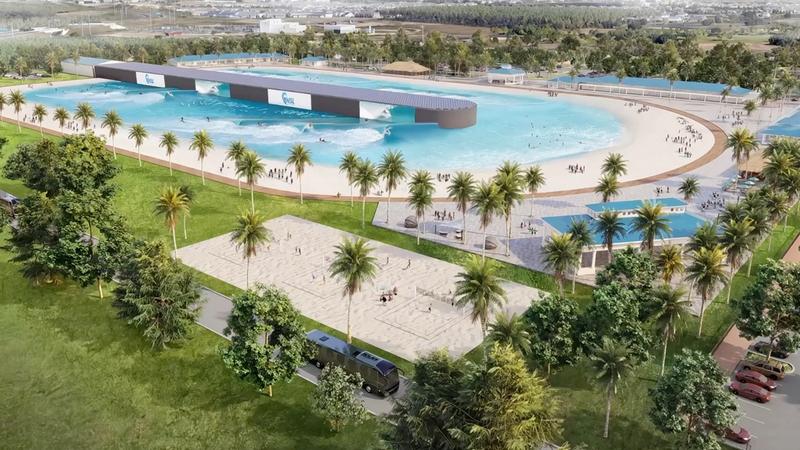
At the center is a single Wavegarden Cove, the same Spanish technology that powers The Wave in Bristol and Alaia Bay in Switzerland. The system can push out up to 1,000 waves an hour and take up to 90 surfers per hour, with wave sizes and shapes that can be dialed from a beginner's whitewater roller up to a head high wall for advanced surfers.
The lagoon is only part of it. The park spans roughly 52,000 square meters and sits inside a much larger masterplan of around 1.3 million square meters, with a surf academy, food and drink outlets, a retail store, a terrace, cabanas, and private event spaces for corporate and school groups. The Hawaiian branding is intentional. The developers are framing the whole site as a nod to the birthplace of modern surfing, dropped into the desert.
The project is being developed by Edamah, the real estate arm of the sovereign wealth backed Bahrain Mumtalakat Holding Company, together with GFH Financial Group, with Poullaides Contracting as the main contractor. The groundbreaking ceremony drew senior figures from both companies, including Shaikh Abdulla bin Khalifa Al Khalifa, who chairs Edamah, a signal of how seriously the state is treating leisure tourism as an economic play.
Why the Gulf keeps doing this
Bahrain is not moving into empty territory. Across the Gulf in the UAE, Surf Abu Dhabi is already open and one of the most talked about wave pools in the world. Built with Kelly Slater Wave Co technology, it makes a single long, powerful wave, and the World Surf League has run a Championship Tour event there in front of the sport's best surfers. It set the tone for the entire region. If Abu Dhabi could conjure a world class wave in the desert, everyone else in the Gulf had a template to follow.
The logic behind these projects is the same logic driving them in Texas or Florida. Build the wave and you no longer depend on a coastline. But the Gulf adds two ingredients most markets do not have: enormous capital from sovereign and state linked funds, and governments actively trying to diversify their economies away from oil by building tourism and entertainment from scratch. A wave pool is a near perfect fit. It is a marquee attraction, it works year round in a hot climate if the water is managed, and it slots neatly into the resort and real estate developments these funds are already building.
Bahrain uses Wavegarden rather than Kelly Slater Wave Co, which matters more than it sounds. Abu Dhabi's tech is built for a single elite wave and low throughput. Wavegarden's Cove is built for volume, up to 90 surfers an hour across zones of different difficulty. One is a stadium wave. The other is a public surf park. The region is now getting both kinds, which is what a real market looks like rather than a single trophy project.
What to watch
The caveat is timing. Ground was broken in July 2025 and the operator still says it will open this year, but as of 7 October 2026 its booking page says bookings are coming soon and no opening date has been given.
Either way, the direction is clear. Within a few years the Middle East will have at least two of the most significant wave pools on Earth within a short flight of each other, in a region that had none a decade ago. For landlocked and coast starved surfers everywhere, that is the whole story of this industry in miniature. The wave is going wherever the money and the will to build it are, and right now a lot of both are pointed at the desert.